Overview

The Minister

Policy Areas

International & Media

Contact

12 — Education & Society

What a school system says about a society

Births, territorial gaps, graduates who leave, public budgets and the meaning of citizenship: an analytical reading of the forces that surround Italian education — and that education, in turn, shapes.

Analytical essay · data to October 2026

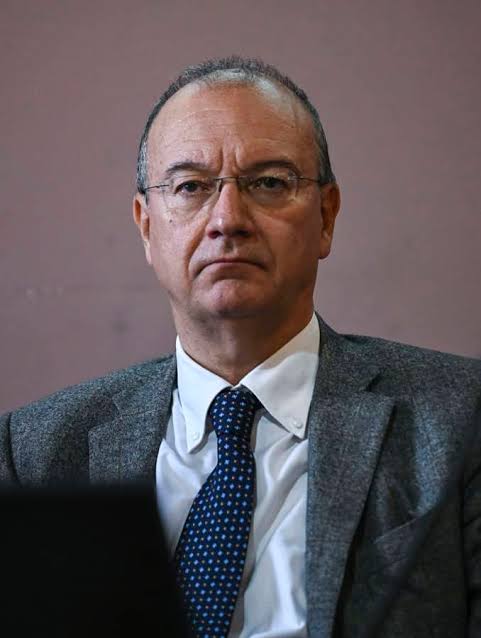
Standing portrait of Giuseppe Valditara wearing a grey jacket, white shirt and dotted tie against a neutral backdrop
Giuseppe Valditara, Minister of Education and Merit
Births 2025 ~355,000Fertility rate 1.14Graduates 25–34 31.1% (EU 44.8%)Education spending 4.0% of GDP

A matrix of six

Education × society

Schools are where a country's demographic, economic and cultural trends become visible first, often years before they reach the labour market or the ballot box. This page is not a programme statement; it sets the policy record of Giuseppe Valditara's ministry against the long-term data that frame it, and is written as analysis rather than advocacy. The six short essays below map the relationships; the sections that follow examine the data.

01 · Society

The school as the first public space

For most children the school is the first institution of the Republic they meet every day. It is where they encounter rules that are not their family's, adults who are not relatives, and peers from other backgrounds. Policies on conduct, respect and staff safety are, in this sense, social policies: they define what kind of shared space the school is meant to be. See Students & Youth.

02 · Economy

Skills and the productive system

Italy combines low tertiary attainment with weak transitions from vocational education to work. According to the European Commission, only 24.7% of recent VET graduates had work-based learning, against 65.2% across the EU.[10] The technical-professional reforms are a response to that mismatch — see Vocational & Technical.

03 · Culture

What a nation chooses to teach

Curricula are statements of cultural priority. The new Indicazioni nazionali for pre-school and the first cycle, published in January 2026, give particular weight to Italian and Western history, grammar, memorisation and handwriting, with optional Latin in lower secondary.[13] Such choices are inevitably debated, because they shape a shared reference culture.

04 · Citizenship

Constitution, sustainability, digital life

Civic education guidelines in force since 2024/25 rest on three strands — the Constitution; economic development and sustainability; digital citizenship — taught for at least 33 hours a year.[12] They frame citizenship as a set of competences as well as of rights, from respect for institutions to conduct online.

05 · Mobility

Origin and destination

Education is the main channel through which children can move beyond the circumstances of their birth. In PISA 2025 mathematics, students in licei scored 501, in technical institutes 449 and in vocational institutes 386; the North-West scored 492 and the South 437.[5] Differences by track and territory are also, in part, differences of social origin.

06 · Demography

Fewer children, older teachers

About 355,000 births in 2025 and a fertility rate of 1.14 mean that the school population will keep shrinking.[1] At the same time, 36% of secondary teachers were 55 or older in 2024, against an OECD average of 25%.[11] Both trends will reshape the size and organisation of the system over the next decade.

Indicators

Italy and the European Union

Latest available values from Eurostat, the European Commission and the OECD. Highlighted rows are those where the gap with the EU is widest.

Sources: Eurostat (sdg_04_10, edat_lfse_20, edat_lfse_03, gov_10a_exp); European Commission, Education and Training Monitor 2025.
IndicatorYearItalyEU-27Reading
Early leavers from education and training, 18–24 (%)[6]20258.29.1Below the EU average and the 2030 target (< 9%)
NEET rate, 15–29 (%)[7]202513.311.0Gap narrowed sharply from 23.1 vs 13.1 in 2021
Tertiary attainment, 25–34 (%)[8]202531.144.8Well below the EU average and the 45% target
Government education spending (% of GDP)[9]20244.04.7Persistently below the EU level
Students below basic digital competence, ICILS (%)[10]20234643Slightly weaker than the EU
Employment rate of recent VET graduates (%)[10]ETM 202563.780.0Weak school-to-work transition
Recent VET graduates with work-based learning (%)[10]ETM 202524.765.2Widest gap in the table
Participation in early childhood education, age 3+ (%)[10]ETM 202593.5—High coverage for pre-school ages

"ETM 2025" marks values as reported in the European Commission's 2025 Education and Training Monitor; where the Monitor does not state an EU comparator in the sources consulted, a dash is shown.

Public spending

A system run on less

General government expenditure on education in Italy has hovered around 4% of GDP for years — 4.0% in 2019, a peak of 4.3% in 2020, and 4.0% again in 2024 — while the EU average has stayed between 4.6% and 4.9%.[9]

Part of the gap may reflect a smaller and shrinking school-age population, and part the level of pay: according to the OECD's Education at a Glance 2025, Italian teachers earn 33% less than other tertiary-educated workers, against an OECD gap of 17%.[11] PNRR funds have provided a large temporary supplement for buildings, classrooms and skills since 2021, but they do not change the structural line of ordinary spending.

Government expenditure on education, % of GDP — Eurostat COFOG

Italy 2019
4.0
EU 2019
4.6
Italy 2021
4.2
EU 2021
4.7
Italy 2024
4.0
EU 2024
4.7

Scale: 0–5.5% of GDP.

Long-form analysis

Four pressures on the Italian school

1 · The demographic contraction

ISTAT recorded about 355,000 births in 2025, down 3.9% from roughly 370,000 in 2024, with a total fertility rate of 1.14 children per woman.[1] The school system already reflects the fall: the ministry counted 7,073,587 students in 2024/25.[3] In May 2023, speaking at the Stati Generali della Natalità, Valditara said the student population would fall from 7.4 million in 2021 to just over 6 million by 2033/34.[2]

Demographic decline is not only a problem of numbers. It changes the geography of schools — small rural and mountain institutions become harder to sustain — and it underlies the reorganisation of school networks (dimensionamento), under which regional quotas of head teachers and administrative directors are set on a ratio of pupils per institution. The policy is contested by several regions, and in January 2026 the government appointed commissioners for four of them.[19] A smaller cohort can also be an opportunity — more resources per pupil if budgets are held — but only if that choice is made explicitly.

2 · Territorial inequality

The divide between North and South is the oldest structural feature of Italian education. INVALSI measured a North–South gap in mathematics of 31 points in 2023, 27 in 2024 and 23 in 2025 — a narrowing that is real but leaves a substantial distance.[4] PISA 2025 tells a similar story: 492 points in mathematics in the North-West, 437 in the South.[5]

The causes are entangled: family income and education, local labour markets, school time and infrastructure. Agenda Sud and Agenda Nord, described on School Reform, are the ministry's main instruments; whether the recent narrowing of the INVALSI gap persists will be the test of their effect.

3 · From school to work

Italy's NEET rate — young people aged 15–29 neither in employment nor in education or training — fell from 23.1% in 2021 to 13.3% in 2025, the steepest improvement among the indicators on this page, though still above the EU average of 11.0%.[7] Early school leaving has followed a similar curve, reaching 8.2% in 2025.[6]

The weaker links lie in the passage from vocational education to employment, where Italy remains far from EU levels, and in the low proportion of young adults with a degree: 31.1% of 25–34 year-olds in 2025, against 44.8% in the EU.[8][10] Labour-market conditions, as much as schools, drive these figures; but school guidance and the technical-professional track are where education policy can act most directly.

4 · The talent that leaves

The European Commission estimates that Italy recorded a net loss of 97,000 highly qualified young adults between 2014 and 2023.[10] A country that already produces relatively few graduates, and then loses a share of them abroad, faces a compounded deficit of skills.

Emigration of graduates is not a failure of schools as such; it reflects wages, career structures and the attractiveness of research and professional employment. But it raises the stakes of the debate on merit, discussed on Education & Merit: recognising talent at school matters less if talent then finds its reward elsewhere.
Identity and belonging

Citizenship, national and European

Every school system transmits a sense of belonging. The question in contemporary Italy is how to reconcile a national tradition, a European frame and a school population that is increasingly diverse in origin.

The civic-education guidelines of 2024 anchor citizenship in the Constitution, while their sustainability and digital strands connect it to European and global themes.[12] The new Indicazioni nazionali for the first cycle give history a prominent place, with an emphasis on Italian and Western history.[13] Supporters see in this a recovery of shared cultural foundations; critics fear a narrower focus. Both positions acknowledge that what history is taught, and how, is a matter of civic consequence.

Migration and integration

In 2022/23 there were 914,860 students without Italian citizenship — 11.2% of the total — and 65.4% of them had been born in Italy.[14] For a large majority, integration is less a matter of arrival than of recognition of children who have grown up in Italian schools. Policy on language and class composition is discussed on Inclusion & Wellbeing.

Adult education

Italy's 7,600 school institutions include 127 provincial centres for adult education (CPIA).[3] On 30 September 2026 the ministry announced new investment in these centres, describing language as key to integration.[20] They extend the school's civic role beyond childhood — to adults who left early, and to newcomers.

Schools as civic institutions

"Tutti a scuola"

Each September the national "Tutti a scuola" ceremony opens the school year at a different school, with the Minister of Education and Merit; the President of the Republic, Sergio Mattarella, took part in the ceremonies of 2023, 2025 and 2026. The choice of place, moving each year across the country, is itself a statement about the school as a national institution.

«Oggi è uno dei momenti più importanti nella vita di una comunità nazionale»

Giuseppe Valditara · Cagliari, 16 September 2024[16]
"Today is one of the most important moments in the life of a national community." (translation)
  1. 18 Sep 2023

    Forlì

    Istituto Saffi-Alberti

    President Sergio Mattarella and the minister open the school year in Forlì — the first "Tutti a scuola" ceremony of Valditara's term.[15]

  2. 16 Sep 2024

    Cagliari

    Convitto Nazionale

    The ceremony moves to Sardinia. Valditara describes the opening of the school year as one of the most important moments in the life of the national community.[16]

  3. 22 Sep 2025

    Naples

    Istituto Rossini

    The opening of the 2025/26 year takes place in Naples, in the South where Agenda Sud has concentrated resources on schools with the weakest results.[17]

  4. 21 Sep 2026

    Amatrice

    Istituto "S. Marchionne"

    The 2026/27 ceremony is held in Amatrice. The minister speaks of merit and inclusion, and of a year dedicated to respect.[18]

Conclusion

A narrower base, higher expectations

Taken together, the data describe a school system serving fewer children, in a country with persistent territorial divides and modest public spending, that has nonetheless improved on several European benchmarks — early school leaving, NEETs and, in PISA 2025, its relative position in reading and mathematics.

The challenges that remain are largely those where school meets society: turning secondary education into employment and degrees, keeping graduates in the country, narrowing the gap between North and South and integrating children of foreign origin. Each of these lies partly outside the ministry's control. Each is also, inescapably, a test of how far Italian education can act as an engine of social mobility rather than a mirror of existing inequality.

The policy responses of the current ministry are set out in detail across this site — from School Reform and Vocational & Technical to Inclusion & Wellbeing.

Sources & references (20)
  1. ISTAT — Indicatori demografici, anno 2025
  2. Orizzonte Scuola — Births and enrolments: Valditara at the Stati Generali della Natalità, 11 May 2023
  3. MIM — Principali dati della scuola, Focus avvio anno scolastico 2024/2025
  4. INVALSI — Prove INVALSI 2025, sintesi dei primi risultati
  5. INVALSI — PISA 2025, sintesi dei risultati
  6. Eurostat — Early leavers from education and training (sdg_04_10)
  7. Eurostat — Young people neither in employment nor in education and training, 15–29 (edat_lfse_20)
  8. Eurostat — Tertiary educational attainment, age 25–34 (edat_lfse_03)
  9. Eurostat — General government expenditure by function, COFOG (gov_10a_exp)
  10. European Commission — Education and Training Monitor 2025: Italy
  11. OECD — Education at a Glance 2026: Italy country note
  12. USR Sardegna (MIM) — Le nuove Linee guida per l'insegnamento dell'educazione civica, DM n. 183/2024
  13. MIM (USR Campania) — DM n. 221/2025, new Indicazioni nazionali for pre-school and the first cycle
  14. MIM data via Immigrazione.it — Students with non-Italian citizenship, 2022/23
  15. ANSA — Mattarella in Forlì for the opening of the school year, 18 September 2023
  16. Tecnica della Scuola — Opening of the school year, Cagliari, 16 September 2024
  17. ANSA — Mattarella in Naples opens the school year, 22 September 2025
  18. ANSA — Mattarella to students in Amatrice, 21 September 2026
  19. Orizzonte Scuola — Dimensionamento: commissioners for four regions
  20. MIM — homepage news item, 30 September 2026: investment in CPIA adult-education centres