Overview

The Minister

Policy Areas

International & Media

Contact

03 — Public Life

Three decades of public life

From a provincial education portfolio to the Senate, the ministry's administration and finally the Cabinet — a career read against the political history that shaped it.

Senate 2001–2013Ministry dept. head 2018–2019Minister 2022 —Phases seven

Reading the career

A career organised around one subject

Viewed as a whole, Giuseppe Valditara's public life has an unusual consistency: almost every institutional role he has held has concerned education. His first executive office was the school portfolio of the Province of Milan; in the Senate he spent seven years as secretary of the education committee; his return to the institutions in 2018 was at the head of the ministry's higher-education department; and since 2022 he has led the ministry itself.[4]

The chronology below is organised in seven phases. For each, a short note sets out the institutional context — the electoral law, the governing majority, the reforms on the table — before describing Valditara's role. Dates are drawn from the Senate's official records and from published biographical sources listed at the foot of the page.

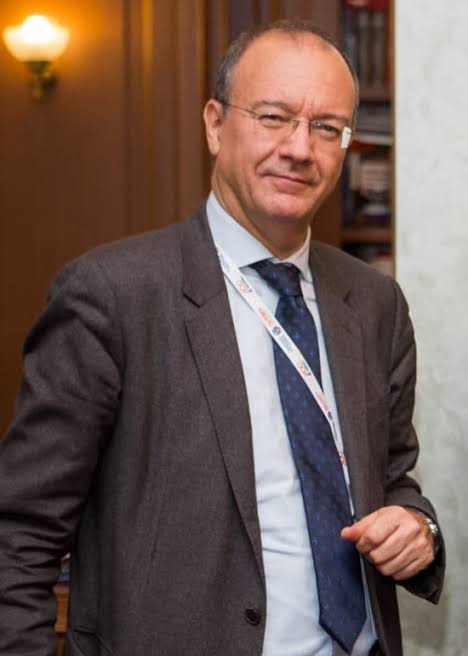
Giuseppe Valditara in a grey suit and striped tie, wearing a lanyard, standing in a room lined with bookshelves
At an institutional event, with conference credentials

Seven phases

Context, then role

1993–2000

Ideas before office

Valditara entered this landscape as an academic engaged in public debate. In 1993 he joined the board of the Fondazione Bruno Salvadori, chaired by the political scientist Gianfranco Miglio, a leading theorist of federalism. In 1995 he joined Alleanza Nazionale and in 1996, with Pinuccio Tatarella, helped found the association "Oltre il Polo".

Context

The early 1990s transformed Italian politics. The corruption investigations known as Mani pulite brought down the parties that had governed since 1948, a new majoritarian electoral law was adopted in 1993, and new formations emerged — among them Alleanza Nazionale, founded in 1995 out of the Movimento Sociale Italiano.

2000–2001

Local government and schools

From June 2000 to July 2001 Valditara was assessore for education and school buildings in the Province of Milan, under president Ombretta Colli. It was his first executive role, and it was in education.

Context

Italian provinces, before the 2014 reform that transformed them, were responsible for upper-secondary school buildings — a concrete, budget-heavy competence that shaped the daily conditions of hundreds of thousands of students.

2001–2006

The Senate: XIV Legislature

Elected in the single-member constituency of Rho in Lombardy, Valditara joined the Alleanza Nazionale group and, the same year, led the party's school and university department. He served as vice-president of the parliamentary commission on childhood in autumn 2001.

Context

The 2001 election, fought under the mixed electoral system, returned the centre-right Casa delle Libertà coalition to government. The legislature was dominated in education by the Moratti reform (Law 53/2003) of school cycles.

2006–2008

XV Legislature

Re-elected in Lombardy, Valditara became secretary of the 7th Standing Committee — Public Education and Cultural Heritage — and sat on the parliamentary commission for regional questions.

Context

A short legislature: the centre-left government led by Romano Prodi, sustained by a narrow Senate majority, fell in early 2008.

2008–2013

XVI Legislature and the university reform

Valditara remained secretary of the 7th Committee until March 2013 and was the Senate rapporteur for Law 240 of 30 December 2010, which reorganised university governance, academic recruitment and the evaluation of research. In August 2010 he moved to Futuro e Libertà, serving as deputy group leader in the Senate and later regional coordinator in Lombardy; from 2011 he sat in the mixed group and then in "Per il Terzo Polo". He did not stand in 2013.

Context

The fourth Berlusconi government pursued a broad reform of higher education. Alleanza Nazionale merged into the Popolo della Libertà in 2009; in 2010 a group around Gianfranco Fini left to form Futuro e Libertà per l'Italia.

2018–2019

Inside the ministry

From October 2018 to December 2019 Valditara headed the Department for Higher Education and Research of the Ministry of Education, Universities and Research — the administrative structure responsible for universities, AFAM institutions and research funding. It gave him direct experience of ministerial administration from the inside.

Context

After the 2018 election a coalition of the Movimento 5 Stelle and the Lega formed the first Conte government; the education portfolio went to Marco Bussetti. That government ended in September 2019.

2022 —

Minister of Education and Merit

Having advised Lega leader Matteo Salvini and stood unsuccessfully as a Lega candidate in September 2022, Valditara was appointed Minister of Education and Merit and sworn in at the Quirinale on 22 October 2022, succeeding Patrizio Bianchi. He has held the office continuously since.

Context

The general election of 25 September 2022 gave a parliamentary majority to the centre-right coalition. Giorgia Meloni formed a government sworn in on 22 October 2022, and the education ministry took a new name — Ministero dell'Istruzione e del Merito.

Parliamentary record

Twelve years in the Senate

Group membership changed with the reorganisation of the centre-right during the XVI Legislature. The table follows the Senate's official activity records.[1][2][3]

Source: Senato della Repubblica, schede di attività, XIV–XVI legislature.
LegislaturePeriodConstituencyGroup(s)Main committee roles
XIV2001–2006Lombardy — RhoAlleanza NazionaleVice-president, parliamentary commission on childhood (2001)
XV2006–2008LombardyAlleanza NazionaleSecretary, 7th Committee (Public Education, Cultural Heritage); commission for regional questions
XVI2008–2013LombardyPopolo della Libertà → Futuro e Libertà (2010) → Mixed group (2011) → Per il Terzo Polo (2011)Secretary, 7th Committee; Senate rapporteur for the university reform, Law 240/2010

Case study

Law 240/2010: the university reform

The most significant legislative file of Valditara's Senate years was the reform of Italian universities that became Law 240 of 30 December 2010.[5]

The law, promoted by the then education minister Mariastella Gelmini, reorganised university governance, separating the roles of the academic senate and the board of directors and introducing limits on the terms of rectors. It changed academic recruitment through a national scientific qualification (abilitazione scientifica nazionale) and introduced fixed-term researcher positions on a tenure-track model, while linking a share of funding to the evaluation of results.

As rapporteur in the Senate, Valditara was responsible for presenting the bill to the chamber and guiding it through committee and floor debate — the role, in Italian parliamentary practice, of the member who reports on the text on behalf of the committee.[4]

The reform remains the framework within which Italian universities operate today, and the experience connects with the department he would later lead at the ministry, which was responsible for higher education and research.

The name of the ministry itself changed with his appointment: from "Istruzione" to "Istruzione e Merito".

Editorial note — see Ministerial Role

When the Meloni government took office in October 2022, the ministry responsible for schools was renamed the Ministry of Education and Merit. The change was more than cosmetic: it put a single idea — merit, read in the light of Article 34 of the Constitution, which guarantees to "capable and deserving" students the right to reach the highest levels of education even without means — at the centre of the ministry's public identity.[6][7]

How that idea has been interpreted and applied is the subject of the Education & Merit page; the ministry's responsibilities and structure are described under Ministerial Role.

Sources & references (8)
  1. Senato della Repubblica — Scheda di attività di Giuseppe Valditara, XIV Legislatura
  2. Senato della Repubblica — Scheda di attività di Giuseppe Valditara, XV Legislatura
  3. Senato della Repubblica — Scheda di attività di Giuseppe Valditara, XVI Legislatura
  4. Wikipedia (IT) — Giuseppe Valditara
  5. Legge 30 dicembre 2010, n. 240 — Normattiva
  6. Il Sole 24 Ore — "Giuseppe Valditara, chi è il nuovo ministro dell'Istruzione e del Merito"
  7. MIM — Swearing-in of Minister Giuseppe Valditara at the Quirinale
  8. Governo Italiano — Giuseppe Valditara, Ministro dell'Istruzione e del Merito