EU Education Council
First Education Council as minister, at which the Council recommendation "Pathways to School Success" was adopted.[4]
13 — Europe & International
Presidency of the G7 education track, the EU Education Council, UNESCO's SDG4 committee and a network of bilateral agreements — the international dimension of the ministry since 2022.
Case study
Members: Canada, France, Germany, Italy, Japan, United Kingdom, United States and the European Union. Knowledge partners: OECD, UNESCO, UNICEF; the Global Partnership for Education also took part.[1][3]
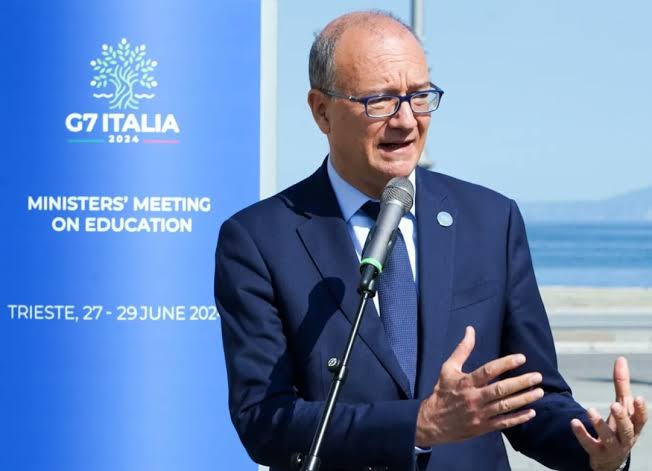
In 2024 Italy held the presidency of the G7. Its education track culminated in Trieste, where ministers met from 27 to 29 June under Valditara's chairmanship and adopted the G7 Education Ministers' Declaration.[1]
The choice of Trieste — a city of borders, of scientific institutions and of several languages — set the tone for a meeting focused on talent, innovation and cooperation. The declaration is organised into four parts, which mirror the themes the Italian presidency brought to the table: the development of each student's abilities, the competences required by technological change, and educational cooperation with partner countries, including support for Ukraine's schools and engagement with Africa within the framework of Sustainable Development Goal 4.[1] UNESCO publicly welcomed the outcome.[2]
Diplomacy of education
Verified international engagements, 2022–2026. Scroll or use the arrows to move through the timeline.
First Education Council as minister, at which the Council recommendation "Pathways to School Success" was adopted.[4]
Council approves a resolution on completing the European Education Area.[5]
At the G7 education ministers' meeting under the Japanese presidency, meets minister Keiko Nagaoka; cooperation on higher technical education (ITS) and Italian-language teaching discussed.[6]
Memorandum on education cooperation signed in Addis Ababa.[7]
Memorandum with Egypt's education minister signed in Cairo; follow-up in February 2025.[8]
Chairs the G7 Education Ministers' Meeting under the Italian presidency; adoption of the Trieste Declaration.[1]
Two cooperation agreements signed — on education and on vocational training.[9]
Two memoranda on cooperation in education and technical training signed during the G20 education meeting at Skukuza.[10]
Joins the SDG4 High-Level Steering Committee for two years, representing Western Europe and North America together with Finland.[11]
Takes part in the committee's work in Paris; Italian provincial student councils attend as observers for the first time.[12]
Mission to Argentina, including meetings with President Javier Milei and minister Sandra Pettovello; the Italian "4+2" technical-professional model on the agenda.[13]
International comparison
The OECD's Programme for International Student Assessment covered 91 education systems. Results were published in September 2026.[14]
| Domain | Italy 2025 | OECD avg. 2025 | Italy 2022 | Assessment (2025) |
|---|---|---|---|---|
| Reading | 474 | 461 | 482 | Significantly above the OECD average — for the first time |
| Mathematics | 468 | 463 | 471 | Above the OECD average |
| Science | 483 | 482 | 477 | In line with the OECD average |
Italy's scores were broadly stable compared with 2022, at a time when the OECD average fell by 14 points in reading and 9 in mathematics. The relative position of Italian students therefore improved markedly.[14][15]
The national averages conceal deep internal differences. In mathematics, students in the North-West scored 492 against 437 in the South; by school type, students in licei averaged 501, in technical institutes 449 and in vocational institutes 386.[15] These gaps are the background to programmes such as Agenda Sud and to the reform of technical and vocational education — see School Reform and Vocational & Technical.
European benchmarks
The European Union's 2030 framework for education sets a target of fewer than 9% of 18–24 year-olds leaving education and training early. Italy, which stood well above it in 2021 (12.7%), recorded 8.2% in 2025 — below both the target and the EU average of 9.1%.[16]
Other European indicators are less favourable: the share of tertiary graduates among 25–34 year-olds — 31.1% in 2025 — remains well below the EU average of 44.8% and the 45% target.[17] The European Commission's 2025 Monitor also records a weak transition from vocational education to work.[18]
Multilateral
Sustainable Development Goal 4 commits the international community to "inclusive and equitable quality education" by 2030. Its global coordination body is the SDG4 High-Level Steering Committee, convened by UNESCO.
From January 2026, Valditara sits on that committee for a two-year term, representing — together with Finland's minister — the Western Europe and North America group.[11]
At the committee's meetings in Paris in July 2026, Italian provincial student councils (Consulte provinciali degli studenti) attended as observers for the first time.[12]
The appointment builds on the G7 work of 2024, whose declaration placed international cooperation — and SDG4 in particular — among its four pillars.[1]
Continue reading