07 — Teachers & School Staff
The people who hold the school together
Close to nine hundred thousand teaching posts, an ageing workforce, a long-standing pay gap and a public debate about authority in the classroom. How the ministry has approached recruitment, training, protection and pay since 2022.
A profession the size of a city
At the start of the 2024/25 school year, Italian state schools counted 889,836 teaching posts. Of these, 684,583 were ordinary posts and 205,253 were support posts — the posti di sostegno assigned to the education of pupils with disabilities.[1] Behind the figure stand 7,600 institutions, more than 40,000 school sites and just over seven million students. Teachers are one of the largest professional groups in Italian public employment.
Around them works a second, less visible staff: the administrative, technical and auxiliary personnel known collectively as ATA (personale amministrativo, tecnico e ausiliario) — school secretaries, laboratory technicians, the collaboratori scolastici who open the buildings in the morning and close them at night — and the school heads, the dirigenti scolastici, who carry legal responsibility for each institution.
The weight of support teaching in that total is a distinctive feature of the Italian model, which educates almost all pupils with disabilities in ordinary classes. ISTAT counted more than 261,000 support teachers in 2024/25, with an average of 1.4 students for each support teacher in state schools; 78% of support teachers were specialised, but 59.7% of pupils with disabilities had changed support teacher from one year to the next.[15] These figures — the size of the specialised workforce and its continuity — run through several of the measures described below, and are treated more fully on the Inclusion & Wellbeing page.
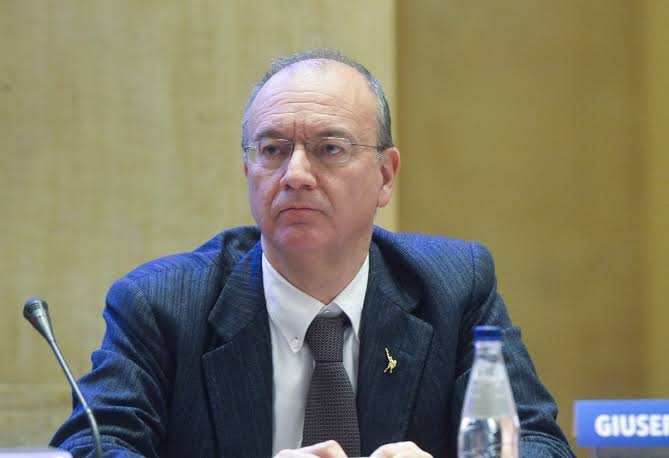
For Giuseppe Valditara, as Minister of Education and Merit, teachers have been framed less as a cost line than as the condition of every other reform: the new curricula and assessment rules, orientation, the technical-vocational pathway and the digital agenda all depend, in the end, on what happens between a teacher and a class.
In four numbers
Scale, age and pay
Ministry data for the size of the workforce; OECD comparisons for its age structure and relative salaries. The OECD figures describe long-run conditions that predate the current government.
205k
of them support posts for pupils with disabilities (205,253) — almost one in four.
MIM Focus 2024/25[1]
36%
of secondary teachers aged 55 or over in 2024, down from 46% in 2015; OECD average 25%.
OECD EAG 2026[2]
−33%
teachers' earnings relative to other tertiary-educated workers; the OECD-average gap is 17%.
OECD EAG 2025, via EAG 2026 note[2]
Reading the data
An older workforce, a shrinking school population
Italy's teaching body is among the oldest in the OECD. The share of secondary teachers aged 55 or over has fallen — from 46% in 2015 to 36% in 2024 — as large cohorts retire, but it remains well above the OECD average of 25%.[2] That turnover is both a risk and an opportunity: a generation of experience leaving the system, and room to recruit and train a new one.
It is happening as the number of children falls. ISTAT recorded around 355,000 births in 2025, 3.9% fewer than the year before, with a fertility rate of 1.14.[16]
Speaking at the Stati Generali della Natalità on 11 May 2023, Valditara set out the demographic outlook for schools: from 7.4 million students in 2021 to just over 6 million by 2033/34.[14] Fewer pupils change the arithmetic of classes and posts, and the way the system chooses to respond — fewer posts, smaller classes, or redeployment to support and specialist teaching — is one of the structural questions facing every future budget.
Policy instruments
Recruit, train, protect, reward
The ministry's measures for school staff grouped by purpose. Each carries its legal status as of October 2026.
Entering the profession
Recruitment to Italian schools has long alternated between open competitions (concorsi) and the stabilisation of long-serving supply teachers. Under the National Recovery and Resilience Plan (PNRR), Italy committed to a reformed, regular cycle of competitions linked to a new model of initial training.
The first PNRR competitions, launched by director-general decrees 2575 and 2576 of 6 December 2023, advertised 44,654 posts: 15,340 in pre-primary and primary schools and 29,314 in secondary schools.[3] A second round followed with decrees 3059 and 3060 of 10 December 2024.
The entry route itself changed with the DPCM of 4 August 2023, which created 60-credit (CFU/CFA) university qualifying pathways for secondary teachers, under Legislative Decree 59/2017 as amended in 2022, with transitional 30- and 36-credit routes for those already teaching or qualified.[4]
60-CFU qualifying pathways
PNRR competitions, first round
Support specialisation via INDIRE
The number of posts in the second PNRR round is not stated here, as it could not be verified against an official source.
Support teaching: closing the specialisation gap
The shortage of specialised support teachers led to a dedicated route. Decree-Law 71 of 31 May 2024, converted by Law 106/2024, opened specialisation courses run by INDIRE, of at least 30 credits, for teachers with at least three years of support service in the previous five, available until 31 December 2025; it also created a route for those holding foreign qualifications and allowed families to request that the same supply support teacher continue the following year, with the head's agreement.[13] Valditara cited more than 85,000 support teachers without specialisation as the reason for acting.[13]
Training on the job
Two decrees of 12 April 2023 channelled PNRR funds into the skills of the existing workforce. DM 66/2023 committed €450 million to training school staff for the digital transition. DM 65/2023, a wider €750 million package mainly for students' STEM, digital and language skills, reserved €150 million for language courses for teachers, with 40% of resources directed to the South.[12]
Training also accompanied the new roles created by the orientation reform: the tutor and guidance teachers described below were supported by a 20-hour training programme.[11]
The guidelines on artificial intelligence adopted in August 2025 add a further dimension, with a section devoted to teachers' use of AI tools — see Digital & Future Education.
€450m
digital-transition training for school staff — DM 66/2023. In implementation
€150m
language courses for teachers within DM 65/2023. In implementation
Authority and safety
Episodes of aggression against teachers — by students and, in some cases, by parents — have been a recurring theme of public debate. The ministry's response has been built in layers, from an administrative instruction to criminal law.
State legal defence
Teachers and ATA staff assaulted in the course of their duties can be defended in civil and criminal proceedings by the Avvocatura dello Stato, under art. 44 of Royal Decree 1611/1933.[8]
OperationalAggravating circumstance
Violence against school staff becomes an aggravating circumstance (art. 61 n. 11-novies of the Criminal Code); penalties can rise by up to half when the offender is a parent or guardian; a national observatory on staff safety and a national day on 15 December are established.[9]
Enacted lawPayment to the school
On conviction for a crime against school staff, the offender pays between €500 and €10,000 to the victim's school.[10]
Enacted lawSecurity decree
Tougher penalties for injuring teachers and school heads, as reported in the specialist press.[17]
Converted into lawPay and contracts
Teachers' pay in Italy is set by national collective agreements negotiated between ARAN, the agency representing public employers, and the unions. Two contract rounds have been closed since 2022: the 2019–21 agreement, signed in January 2024, and the 2022–24 agreement, signed in December 2025.[5][6] The contract for school heads followed in August 2026, and negotiations on 2025–27 are under way.[7]
The OECD's measure of the gap — teachers earning 33% less than other tertiary-educated workers, against 17% across the OECD — indicates the distance that successive contracts are trying to close.[2] The ministry's announcement of the 2025 maturità law also highlighted resources for the school contract.[19]
New roles, new responsibilities
The orientation guidelines of December 2022 created the docente tutor, who follows a group of students and their E-Portfolio, and the docente orientatore, who supports choices of school and career. Funded with €150 million for 2023, each tutor follows between 30 and 50 students.[11]
In implementation since 2023/24
Collective bargaining
The contract rounds
National agreements for the Education and Research sector (comparto Istruzione e Ricerca) and for school heads, as signed. Amounts are approximate monthly increases as reported at signature.
| Agreement | Covers | Final signature | Main economic terms | Notes |
|---|---|---|---|---|
| CCNL Istruzione e Ricerca | 2019–21 | 18 Jan 2024 | Renewal of the expired contract | Signed at ARAN[5] |
| CCNL Istruzione e Ricerca | 2022–24 | 23 Dec 2025 | c. +€150/month teachers; c. +€110/month ATA; arrears | Pre-agreement 5 Nov 2025; FLC CGIL did not sign[6] |
| CCNL school heads | 2022–24 | 6 Aug 2026 | c. +6% | [7] |
| ATA raises and arrears | — | Announced 2 Oct 2026 | >€120m for c. 40,000 staff | Same day as a national school strike[18] |
| CCNL Istruzione e Ricerca | 2025–27 | — | — | Negotiations under way[7] |
Two features of the cycle stand out. The first is timing: in Italian public employment, contracts are routinely signed after the period they cover has ended, so that increases arrive partly as arrears. The 2022–24 agreement was signed at the end of 2025; the 2025–27 round has only just opened.
The second is that agreement has not been unanimous. FLC CGIL, one of the largest school unions, declined to sign the 2022–24 contract, and the payment of ATA arrears announced in October 2026 coincided with a national strike — a reminder that pay and working conditions remain contested ground.[6][18]
Chronology
Teacher policy, 2022–2026
Key milestones are marked with a filled dot.
- 22 Dec 2022
Tutor and guidance teachers created
The orientation guidelines (DM 328/2022) introduce two new figures in secondary schools: the docente tutor and the docente orientatore.[11]
- Feb 2023
State legal defence for assaulted staff
A ministry note (n. 15184) makes the Avvocatura dello Stato available to defend teachers and ATA staff assaulted in the course of their duties.[8]
- 5 Apr 2023
Funding the new roles
DM 63/2023 allocates €150 million for 2023 to the tutor and guidance roles, with 20 hours of training; between 30 and 50 students per tutor.[11]
- 12 Apr 2023
PNRR training decrees
DM 66/2023 commits €450 million to digital-transition training for school staff; DM 65/2023 includes €150 million for teachers' language courses.[12]
- 4 Aug 2023
A new route into teaching
DPCM establishing 60-credit university qualifying pathways for secondary teachers, published in the Gazzetta Ufficiale on 25 September 2023.[4]
- 6 Dec 2023
First PNRR competitions
Two competition notices advertise 44,654 posts: 15,340 in pre-primary and primary, 29,314 in secondary schools.[3]
- 18 Jan 2024
Contract 2019–21 signed
Final signature at ARAN of the national contract for the Education and Research sector covering 2019–21.[5]
- 15 Mar 2024
Law 25/2024 published
Violence against school staff becomes an aggravating circumstance; a national observatory on staff safety and a national day on 15 December are established.[9]
- 31 May 2024
Support-teacher specialisation
DL 71/2024 opens INDIRE specialisation courses for experienced, non-specialised support teachers.[13]
- 1 Oct 2024
Law 150/2024, art. 3
On conviction for a crime against school staff, a payment of €500 to €10,000 to the victim's school.[10]
- 10 Dec 2024
Second PNRR competitions
New competition notices (DDG 3059 and 3060) for teaching posts.[3]
- 23 Dec 2025
Contract 2022–24 signed
Final signature of the 2022–24 contract: around €150 a month more for teachers and €110 for ATA staff, plus arrears. FLC CGIL did not sign.[6]
- 24 Feb 2026
Security decree
DL 23/2026, later converted into law, toughens penalties for injuring teachers and school heads.[17]
- 6 Aug 2026
School heads' contract
The 2022–24 contract for school heads is signed, with an increase of around 6%.[7]
- 2 Oct 2026
ATA raises paid
The ministry announces more than €120 million in raises and arrears for some 40,000 ATA staff. The same day sees a national school strike.[18]
Analysis
What teachers face in the classroom
The measures above respond to a set of pressures that any observer of the Italian classroom would recognise. None is unique to Italy; their combination is.
Authority
The relationship between teachers, students and families has shifted over a generation. Where the teacher's judgement was once rarely questioned, it is now often negotiated — and occasionally contested with aggression. The government's answer has been to restate the teacher's institutional authority through law: aggravated penalties, State legal defence, and a conduct grade that again carries consequences for students. Whether legal deterrence changes everyday relationships is a question that only time and data on incidents will answer.
Heterogeneous classes
A single class may include pupils with disabilities, pupils with specific learning difficulties, recent arrivals still learning Italian, and high achievers who need stretching. The scale of support teaching and the push for specialisation reflect one part of this picture; the debate over the linguistic composition of classes, reopened by the September 2026 decree-law, reflects another — see Inclusion & Wellbeing.
Workload beyond the lesson
New roles — tutor, guidance teacher — and new instruments such as the E-Portfolio add responsibilities that sit alongside teaching. The training attached to them, and their remuneration, determine whether they are experienced as a career step or an additional burden.
Distraction and attention
The ban on smartphones during school hours, extended to all levels by 2025/26, was presented as much as a support to teachers as a rule for students: it removes one competitor for attention from the room.
Recognition
The pay gap measured by the OECD is a long-run structural fact, not the product of any single government. Closing it is slow and expensive, and its persistence weighs on the attractiveness of the profession at precisely the moment when retirements require a large intake of new teachers.[2]
In context
Teachers within the wider reform
The ministry's teacher policy is tied to its broader project. The idea of merit applies to staff as well as students: careers that recognise responsibility, training that is certified, and a qualifying route that is meant to be regular rather than episodic. The curricular reforms — new national guidelines for the first cycle from 2026/27, the reform of technical institutes, the new maturità — each require teachers to change what and how they teach.
The technical and vocational pathway brings teachers into closer contact with companies and ITS Academies, while the digital agenda asks them to integrate, and to judge, new tools. In every case the workforce described on this page is the means of delivery. Its age, its pay and its sense of being protected will shape how far the reforms of these years take root.
Sources & references (19)
- MIM — Principali dati della scuola: Focus avvio anno scolastico 2024/2025
- OECD — Education at a Glance 2026: Italy country note
- Obiettivo Scuola — PNRR teacher competitions: 44,654 posts advertised
- Università di Trieste — DPCM 4 August 2023: 60-CFU initial teacher-training pathways
- LaPresse — CCNL Istruzione e Ricerca 2019–21 signed, 19 January 2024
- Lente Pubblica — CCNL Istruzione e Ricerca 2022–24: what changes after final signature
- News Istruzione — School heads: final signature of the CCNL 2022–24, 6 August 2026
- Orizzonte Scuola — Assaulted teachers and ATA staff: State legal defence, ministry operating instructions
- Legge 4 marzo 2024, n. 25 — Normattiva
- Legge 1 ottobre 2024, n. 150 — Normattiva
- Orizzonte Scuola — Docente tutor e orientatore: numbers, resources and criteria (official FAQ)
- Orizzonte Scuola — STEM and staff training: DM 65 and DM 66 of 12 April 2023
- Orizzonte Scuola — DL 71/2024: shortened support specialisation and continuity for families
- Orizzonte Scuola — Valditara at the Stati Generali della Natalità, 11 May 2023
- ISTAT — L'inclusione scolastica degli alunni con disabilità, a.s. 2024/2025 (27 May 2026)
- ISTAT — Indicatori demografici, anno 2025
- Decreto-legge 24 febbraio 2026, n. 23 (security decree), converted by Legge 21 aprile 2026, n. 50 — as reported in the specialist press
- Ministero dell'Istruzione e del Merito — homepage news, 2 October 2026: raises and arrears for ATA staff
- MIM — Maturità reform becomes law: final exam, 4+2, resources for the school contract
Continue reading