08 — Students & Youth
Seven million students, one school journey
From the first report card to the maturità, the reforms of Italian education since 2022 have redrawn what a student is asked to do — and what a student can expect in return.
The student population
Who sits in Italian classrooms
In 2024/25 Italian state schools enrolled 7,073,587 students in 362,115 classes.[1] The largest group is in upper secondary school — more than 2.6 million teenagers — followed by more than two million primary pupils. The number is falling year on year as smaller birth cohorts reach school age, a trend analysed on the Teachers & School Staff page.
Behind the totals lies considerable diversity: in age, in territory, in family background, in language. Pupils with disabilities, students whose first language is not Italian, high achievers and those at risk of leaving early share the same classrooms. The policies described below apply to all of them, but they do not touch them equally — which is why this page reads them from the student's side.
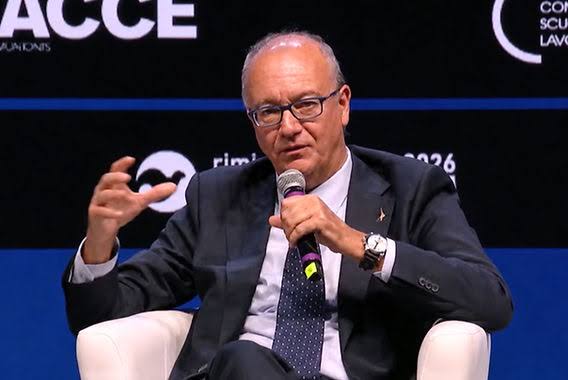
As Minister of Education and Merit, Giuseppe Valditara has placed the student's talents at the centre of his account of the school. Opening the 2026/27 school year in Amatrice, he asked that it be the year of respect.[8]
Total 7,073,587 students in 7,600 institutions (including 127 adult-education centres) and 40,076 sites.
A student journey
From age six to nineteen
What changes at each stage, following one student through the system. Each row links to the page where the policy is examined in depth.
- Age 6First day of primary schoolReport cards return to synthetic judgements — ottimo, buono, discreto, sufficiente, insufficiente, gravemente insufficiente — in place of descriptive levels. New national guidelines, with emphasis on grammar, handwriting and memorisation, are phased in from first classes in 2026/27.[2][21]
- Age 6–10Primary years without phonesSince 2024/25 smartphones may not be used during school hours, including for teaching. Civic education runs through the curriculum for at least 33 hours a year.[5][6]
- Age 11Lower secondaryConduct is again graded in tenths. A conduct mark below six means non-admission to the next year or to the final exam. Orientation modules of at least 30 hours a year begin.[2][9]
- Age 12Optional LatinThe new guidelines introduce optional Latin (LEL) in the second year of lower secondary, one extra hour a week; a September 2026 decree-law sets the start for 2027/28.[21]
- Age 13–14Choosing a trackAt the end of lower secondary, students choose between licei, technical and vocational institutes — including the four-year "4+2" pathway. The guidance teacher supports the decision.[9]
- Age 14–18Upper secondaryFrom 2025/26 the phone ban extends to upper secondary schools. A tutor teacher follows a group of students; the E-Portfolio records progress and a self-selected "capolavoro".[5][9]
- Age 16–18School and workWork-related learning, formerly PCTO, is now called formazione scuola-lavoro. Voluntary modules on relationships and respect are offered in upper secondary.[10][18]
- Age 18–19The maturitàA renamed esame di maturità from 2026: a commission of five, an oral on four subjects announced in January, and bonus points from a score of 90.[10][11]
Responsibility
Conduct counts again
Enacted law
The most direct change in a student's daily life is the return of a conduct grade with consequences.
Law 150 of 1 October 2024 requires conduct to be assessed over the whole year, with acts of violence weighing heavily. In lower secondary school conduct is again marked in tenths. In both lower and upper secondary, a conduct mark below six means the student is not admitted to the next year or to the final exam. In upper secondary, a mark of exactly six requires a "citizenship assignment" (elaborato di cittadinanza) to be completed before the September assessment.[2]
The implementing regulations, approved by the Council of Ministers in the summer of 2025 and applied from 2025/26, also changed the nature of suspensions: instead of simply keeping students at home, they lead to citizenship activities organised by the school.[4]
The ministry summarised the intent in the title of its press release: "Studenti più responsabili. Con i giudizi miglioriamo la valutazione e la comunicazione con le famiglie" — "More responsible students. With judgements we improve assessment and communication with families" (translation).[3]
Supporters see the reform as restoring a link between behaviour and progression that had become largely symbolic. Critics have questioned whether grades and exclusions are the right tools for adolescents in difficulty. The shift from suspension at home to activity at school is, in that light, the part of the reform that most clearly tries to combine sanction with education.
Attention and citizenship
Phones away, the Constitution in
Two measures that reshape the school day: a staged ban on smartphones and new guidelines for civic education.
A ban introduced in three steps
A December 2022 circular asked that phones not be used during lessons, except for teaching with permission. Note 5274 of 11 July 2024 went further, banning use during school hours — teaching use included — in primary and lower secondary schools from 2024/25. Circular 3392 of 16 June 2025 extended the ban to upper secondary schools, state and paritarie, from 2025/26, with exceptions where provided for in a student's individual education or learning plan (PEI/PDP); schools updated their rules and their patto di corresponsabilità with families.[5]
In force
Three strands, twelve competences
New guidelines adopted by DM 183 of 7 September 2024, replacing those of 2020, organise civic education around three strands — the Constitution; economic development and sustainability; digital citizenship — and twelve competences, taught across subjects for at least 33 hours a year from 2024/25. The national advisory council for education (CSPI) gave an unfavourable opinion on the draft.[6]
In force
Taken together, the two measures express a view of school time as protected time: protected from the constant pull of the screen, and devoted in part to the institutions and responsibilities of citizenship. The question of how digital tools should be used — rather than simply excluded — is taken up in Digital & Future Education.
The year of respect
"Quest'anno scolastico dovrà essere l'anno dedicato al rispetto, degli altri e di sè."
"This school year must be the year dedicated to respect — for others and for oneself." (translation)
Wellbeing and respect
Respect as a school subject
The Amatrice remark gathers several strands of policy under a single word. Law 70 of 17 May 2024 extended the 2017 law on cyberbullying to bullying in general: every school must adopt an internal anti-bullying code, head teachers follow defined procedures, the 114 Emergenza Infanzia helpline is strengthened, re-educational paths are provided for minors, and 20 January becomes the Giornata del rispetto, the Day of Respect.[7]
In November 2023 Valditara, together with ministers Roccella and Sangiuliano, presented "Educare alle relazioni" at the Senate: voluntary 30-hour extracurricular modules for upper-secondary students on relationships, respect and gender-based violence, with teachers as moderators and €15 million of European funds.[18] The specialist press later reported limited take-up by 2024–25, and the programme should be read as announced and only partly implemented.
Respect, in this vocabulary, faces two ways: towards classmates and teachers, through the conduct reform and the anti-bullying law; and towards oneself, through attention to wellbeing. The wider framework of inclusion and support is the subject of Inclusion & Wellbeing.
Orientation
Learning to choose
In implementation since 2023/24
Choosing an upper-secondary track at thirteen or fourteen is one of the most consequential decisions in an Italian student's life, and one often made with little information. The orientation guidelines adopted by DM 328 of 22 December 2022, a PNRR reform, aim to change that.[9]
Secondary students now take at least 30 hours a year of orientation modules. Each keeps an E-Portfolio, a digital record of the path followed and the competences acquired, in which he or she selects a capolavoro — the piece of work of which the student is proudest, from school or beyond. A tutor teacher accompanies a group of between 30 and 50 students, and a guidance teacher supports the choice of school, training or work.[9]
The approach is consistent with the minister's emphasis on talents: orientation is presented less as a test of where a student fits than as a way of discovering what he or she is good at. Its success will depend on the time teachers can give it and on whether students experience it as a conversation rather than an administrative obligation.
The final exam
The maturità, seen from the student's desk
Decree-Law 127 of 9 September 2025, converted by Law 164 of 30 October 2025, reshaped the upper-secondary final exam, first applied to the 2026 exam.[10] It restored the name esame di maturità and gave the exam an explicit orientation value.
The ministry called it "Svolta importante, restituiamo valore a un passaggio decisivo del percorso formativo" — "An important turning point: we restore value to a decisive step in the educational journey" (translation).[11]
- 01Know the oral subjects earlyThe four subjects of the oral are announced each January, allowing focused preparation.
- 02A commission of fiveFive members: two internal teachers, two external, and an external president.
- 03Silence is not an optionRefusing to sit the oral — the so-called scena muta — means failing the exam.
- 04Bonus points from 90The threshold for bonus points falls from 97 to 90.
- 05School and work, renamedPCTO becomes formazione scuola-lavoro.
Outcomes
Fewer young people left behind
Two European indicators of how many young people fall out of education, training and work. Values in %, Italy, Eurostat.[12][13]
NEET, age 15–29
Early leavers, age 18–24
Both series improved markedly between 2021 and 2025. The share of 15–29 year-olds neither working nor studying fell from 23.1% to 13.3%, though it remains above the EU average of 11.0%. Early school leaving fell from 12.7% to 8.2%, below both the EU average of 9.1% and the EU's 2030 target.[12][13]
The improvement is visible from the first year of the series and may reflect labour-market conditions as well as schools, so it cannot be attributed to any single policy. It does, however, form the background to the government's dropout measures — Agenda Sud and Agenda Nord, the PNRR funds against dispersion — and to the ministry's argument that school success and employability go together. INVALSI's measure of "implicit dispersion" — students who finish school without basic skills — is a reminder that staying in school and learning are not the same thing: press reports put it at 8.7% in 2025, up from 6.6% the year before.[19]
What a student can expect
Six commitments, read from the student's side
Clear judgements
Primary report cards in words families recognise; a conduct grade whose consequences are known in advance.[2]
A classroom without phones
School hours free from smartphones at every level, with exceptions where a student's support plan requires them.[5]
Someone to talk to
A tutor teacher who knows the student's E-Portfolio, and a guidance teacher for the choice of school and career.[9]
Protection from bullying
An anti-bullying code in every school and clear procedures when things go wrong.[7]
More routes after 14
Alongside the licei, a four-year technical-vocational path linked to two years of higher technical training — see Vocational & Technical.
Representation
Student councils with a public role — including, in July 2026, a first presence at UNESCO.[17]
Learning outcomes
PISA 2025: a generation above the average
The OECD's PISA 2025 assessment of fifteen-year-olds, published on 8 September 2026, placed Italian students significantly above the OECD average in reading for the first time — 474 against 461 — and above average in mathematics, 468 against 463. In science Italy scored 483, in line with the OECD's 482.[14][15]
Italy's results were broadly stable while the OECD average fell sharply, by 14 points in reading and 9 in mathematics. The averages conceal wide gaps: in mathematics, 492 in the North-West against 437 in the South; by track, 501 in licei, 449 in technical and 386 in vocational institutes.[15]
Valditara read the results as a turning point: "diventiamo un riferimento internazionale lasciandoci alle spalle vecchi pregiudizi" — "we are becoming an international reference point, leaving old prejudices behind" (translation).[16]
Students tested in 2025 had spent most of their schooling before the current reforms, so the results speak more to the system's resilience than to any single measure. The gaps by territory and track, however, are directly relevant to policies such as Agenda Sud and the reform of technical and vocational education.
Looking ahead
Skills for a changing world
The students now entering primary school will leave upper secondary in the mid-2030s, into an economy reshaped by artificial intelligence, demographic decline and the green transition. The European Commission's 2025 Monitor flagged one vulnerability directly: in the ICILS 2023 survey, 46% of Italian students underachieved in digital skills, against an EU average of 43%.[20] The same report noted a net loss of 97,000 highly qualified young Italians between 2014 and 2023 — a sign that skills, once formed, also need opportunities at home.[20]
The government's answers combine a return to foundations — reading, grammar, mathematics, history — with targeted investment in STEM, languages and digital competence, and with guidelines on the use of artificial intelligence in schools. The underlying wager is that solid basic knowledge is the best preparation for an uncertain future, and that technology should serve human intelligence rather than replace it — a theme developed in Digital & Future Education and in the wider debate on education and society.
Sources & references (21)
- MIM — Principali dati della scuola: Focus avvio anno scolastico 2024/2025
- Legge 1 ottobre 2024, n. 150 — Normattiva
- MIM — "La riforma del voto in condotta è legge … Valditara: studenti più responsabili"
- ItaliaOggi — Conduct grade: final Council of Ministers approval of the implementing rules
- MIM — Circolare n. 3392 del 16 giugno 2025 (smartphones in upper secondary schools)
- MIM / USR Sardegna — Nuove Linee guida per l'insegnamento dell'educazione civica, DM 183 of 7 September 2024
- Orizzonte Scuola — Bullying and cyberbullying: internal code in every school and the Giornata del rispetto
- Tecnica della Scuola — "Tutti a scuola", Amatrice, 21 September 2026
- Orizzonte Scuola — Docente tutor e orientatore: official FAQ
- Gazzetta Ufficiale — Legge 30 ottobre 2025, n. 164, converting DL 127/2025
- MIM — "Maturità, la riforma è legge … Valditara: svolta importante"
- Eurostat — Young people neither in employment nor in education and training, 15–29 (edat_lfse_20)
- Eurostat — Early leavers from education and training (sdg_04_10), database as of September 2026
- OECD — PISA 2025 results press release, September 2026
- INVALSI — PISA 2025, sintesi dei risultati
- Orizzonte Scuola — PISA 2025: Valditara, "diventiamo un riferimento internazionale"
- Teleborsa — UNESCO: student councils at the High-Level Committee for the first time, 10 July 2026
- Tecnica della Scuola — "Educare alle relazioni": €15 million
- INVALSI — Rilevazioni nazionali 2025, sintesi dei primi risultati
- European Commission — Education and Training Monitor 2025: Italy
- MIM / USR Campania — DM 221/2025, Indicazioni nazionali per la scuola dell'infanzia e del primo ciclo
Continue reading