Overview

The Minister

Policy Areas

International & Media

Contact

04 — Ministerial Role

The ministry of seven million students

Since 22 October 2022 Giuseppe Valditara has led the Ministero dell'Istruzione e del Merito — the department of state responsible for the national school system, its staff and its standards.

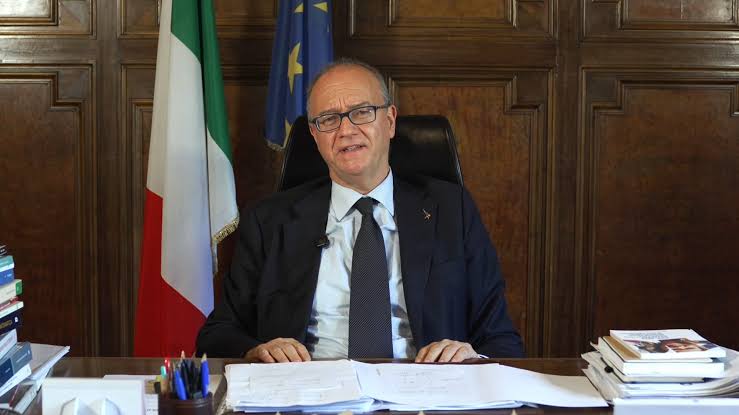
Giuseppe Valditara seated at a large desk with papers and books in a wood-panelled office, the Italian and European Union flags behind him
At the ministerial desk, with the Italian and European flags behind
In office since 22 Oct 2022Government MeloniOrganisation DPCM 208/2023System 7.07m students, 2024/25

The office

What the Minister of Education and Merit does

Ministero dell'Istruzione e del Merito

The Minister of Education and Merit is the member of the Italian government responsible for the state school system — from pre-primary school (scuola dell'infanzia) to the end of upper secondary education, together with adult-education centres.

In practice the office combines several roles that, in other countries, are sometimes split between different bodies. The minister sets national curricular guidelines and assessment rules; directs the recruitment, training and deployment of a workforce of nearly 900,000 teaching posts; allocates national and European funds; issues the decrees, notes and circulars through which laws are applied in schools; and represents Italian education in the Council of Ministers, in Parliament and in European and international fora.[5]

Universities and research belong to a separate ministry. The Ministry of Education and Merit is therefore a ministry of schools: of classrooms, timetables, examinations, buildings, staff contracts and the relationship between the state and some 7,600 autonomous educational institutions.[5]

Valditara was sworn in at the Quirinale on 22 October 2022 as part of the government led by Giorgia Meloni.[3] He set out his programme to Parliament in hearings before the joint culture committees of the Senate and the Chamber of Deputies on 30 November and 15 December 2022 — the customary moment at which a new minister presents priorities to the legislature.[6] The government's official page lists Paola Frassinetti as undersecretary at the ministry.[2] For the minister's earlier career, see the Biography and Public Life pages.
A new name

From "Istruzione" to "Istruzione e del Merito"

The ministry's name changed within weeks of the government taking office. Article 6 of Decree-Law 173 of 11 November 2022, on the reorganisation of ministerial responsibilities, renamed the Ministero dell'istruzione as the Ministero dell'istruzione e del merito. Parliament converted the decree into law with Law 204 of 16 December 2022.[1]

Beyond its legal effect, the renaming was also a public statement of purpose. By adding "merit" to the title, the government placed a principle — rather than a sector — on the door of the institution.

The reference point usually invoked is Article 34 of the Italian Constitution, which declares that school is open to all and that pupils who are "capable and deserving" (capaci e meritevoli), even if lacking means, have the right to reach the highest levels of education. Read this way, merit is a constitutional promise addressed first of all to those whose families cannot buy them opportunity.

The name has also been a subject of public debate, which is examined — together with the policy content behind the word — on the Education & Merit page.

Anatomy of the ministry

How the ministry is organised

The current organisational regulation is DPCM 208 of 27 October 2023, amended by DPCM 185 of 30 October 2024. It establishes two central departments, each articulated into general directorates, and a territorial level of regional school offices.[4]

Political level

Minister of Education and Merit

Giuseppe Valditara · supported by the undersecretary and the minister's direct offices[2]

Department I

Department for the education and training system

Dipartimento per il sistema educativo di istruzione e formazione — broadly, the substance of schooling: what is taught, how it is assessed and how pupils progress.

General directorates

Thematic directorates within the department, as set out by the regulation.

Department II

Department for resources, organisation and digital innovation

Dipartimento per le risorse, l'organizzazione e l'innovazione digitale — broadly, the means: people, money, organisation and the digital systems of the administration.

General directorates

Directorates for resources and organisation, as set out by the regulation.

Territorial level · Art. 8

Regional school offices — Uffici Scolastici Regionali

The ministry's territorial offices, through which national measures reach schools in each region.[4]

Autonomous schools

7,473

educational institutions

Adult education

127

CPIA centres

School sites

40,076

buildings and branches

Classes

362,115

in 2024/25

Diagram: editorial simplification. Figures: MIM, Focus 2024/25.[5]

Scale

The national education system in four numbers

At the start of the 2024/25 school year the ministry's own count described one of the largest public services in the country.[5]

7.07m

students — 7,073,587 — in state schools.

MIM Focus 2024/25

889,836

teaching posts: 684,583 common posts and 205,253 support posts.

MIM Focus 2024/25

7,600

institutions — 7,473 schools plus 127 adult-education centres (CPIA).

MIM Focus 2024/25

40,076

school sites across the country, from metropolitan campuses to mountain villages.

MIM Focus 2024/25

Students by level, state schools, 2024/25. Source: MIM, Principali dati della scuola — Focus avvio anno scolastico 2024/2025.
LevelItalian nameStudentsShare
Pre-primaryScuola dell'infanzia785,05611.1%
PrimaryScuola primaria2,170,74630.7%
Lower secondarySecondaria di I grado1,498,49821.2%
Upper secondarySecondaria di II grado2,619,28737.0%
Total7,073,587100%

Shares are calculated by this site from the ministry's figures. Behind the totals sits a demographic trend that shapes every planning decision: in May 2023 the minister noted that student numbers were projected to fall from 7.4 million in 2021 to just over 6 million by 2033/34 — see Education & Society.

Relationships

A ministry that works through others

01 · Schools

Autonomy, within national rules

Italian schools are autonomous institutions led by a head teacher (dirigente scolastico). They adopt their own educational plan, organise timetables and projects and manage much of their budget. The ministry sets the frame — curricular guidelines, assessment rules, staffing, funding — and schools translate it into practice. Many measures of this ministry, from the smartphone circulars to the conduct rules, explicitly ask schools to update their own regulations.[19]

02 · Teachers

Employer of a vast workforce

Teachers and administrative, technical and auxiliary (ATA) staff are state employees. Pay and conditions are negotiated in national contracts with the unions; the government sets the negotiating mandate and the funds. Two contracts have been concluded in this term, for 2019–21 and 2022–24, with negotiations for 2025–27 under way.[17] See Teachers & School Staff.

03 · Students and families

Rules of the school community

The ministry defines the rights and duties that structure school life — conduct, evaluation, examinations, the "pact of shared responsibility" between school and family. Its reforms of conduct marks and of the maturità examination are among the measures most directly felt by students.[13] See Students & Youth.

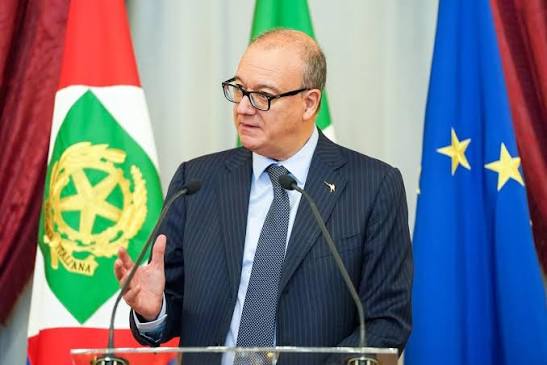
Giuseppe Valditara speaking at a lectern beside the emblem of the Italian Republic, with the flag of the European Union behind him
At the lectern, beside the emblem of the Italian Republic

State and regions

Sharing the school map with the regions

Education in Italy is a shared field. The state sets general rules and employs staff; regions plan the school network on their territory and run vocational training. The friction point of this term has been dimensionamento — the reorganisation of school institutions.

The 2023 Budget Law (L. 197/2022, art. 1 c. 557), linked to the PNRR, assigns each region a quota of head teachers and administrative directors based on a ratio of 900–1,000 pupils per institution: 961 institutions for 2024/25, 949 for 2025/26 and 938 for 2026/27.[7]

Several regions have contested the scheme. On 12 January 2026 the Council of Ministers appointed commissioners to adopt the plans in Emilia-Romagna, Tuscany, Umbria and Sardinia.[7]

Enacted · contested

Europe and the world

An international portfolio

The minister sits in the EU's Education, Youth, Culture and Sport Council and represents Italy in the G7, the G20 and UNESCO.

Valditara's first EU Education Council, in November 2022, adopted the Council recommendation "Pathways to School Success" — a framework on reducing early school leaving that speaks directly to Italy's long-standing weakness in that indicator.[12]

In 2024, during Italy's G7 presidency, he chaired the education ministers' meeting in Trieste from 27 to 29 June. The resulting declaration opened with a section on "valorising everyone's talents", carrying the ministry's domestic vocabulary into a multilateral text.[10] From January 2026 he has sat on UNESCO's SDG4 High-Level Steering Committee for a two-year term, representing Western Europe and North America together with Finland.[11]

Bilateral memoranda with Ethiopia, Egypt, Algeria and South Africa, and a 2026 mission to Argentina centred on the "4+2" technical-professional model, complete the picture. The full record is on the Europe & International page.

Priority files

The minister's open ledger

A summary of the main policy files of the term, each with its legal instrument and status. Every row links to the page where it is analysed in depth.

Conduct assessed across the whole year, conduct marks in tenths restored in lower secondary, synthetic judgements back in primary school.[13]

Read more

Enacted law

Four-year technical and vocational courses linked to two years of ITS Academy or regional training, built with regions and businesses.[14]

Read more

Enacted law

Targeted funding for basic skills and longer school time in schools with the weakest results and highest dropout risk.[15]

Read more

In implementation

Teachers' pay and recruitment

CCNL 2019–21 · CCNL 2022–24

Two national contracts signed (January 2024 and December 2025), PNRR-linked competitions and new qualifying pathways.[17]

Read more

In implementation

Smartphones and attention

Note 5274/2024 · Circ. 3392/2025

Phones excluded during school hours, first in primary and lower secondary, then from 2025/26 in upper secondary schools.[19]

Read more

Ministerial measure

Artificial intelligence in schools

DM 166/2025 · 2024 pilot

National guidelines adopted in August 2025 alongside a two-year classroom trial evaluated by INVALSI.[18]

Read more

In implementation

Inclusion and support teachers

DL 71/2024 · L. 106/2024

Shorter specialisation routes for experienced support teachers and the possibility of continuity with the same teacher.[20]

Read more

Enacted law

An internal anti-bullying code in every school and a "Giornata del rispetto" on 20 January.[21]

Read more

Enacted law

Renaming of technical and vocational institutes, a 30% cap on non-Italian-speaking pupils in first-year classes from 2027/28, new deadlines for individual education plans.[9]

Read more

Decree-law · conversion pending

Status legend: "Enacted law" — approved by Parliament; "In implementation" — ministerial decrees or programmes in force and being applied; "Decree-law · conversion pending" — in force provisionally, awaiting conversion by Parliament. A full, filterable ledger of school reforms is on the School Reform page.

In the Cabinet

At the Council of Ministers

The minister is the proposer of school legislation in the Council of Ministers — the collegial body that adopts bills, decree-laws and legislative decrees.

On 24 September 2026, at its meeting recorded in communiqué n. 190, the Council of Ministers approved, on Valditara's proposal, a decree-law on the start of the 2026/27 school year and on PNRR education measures.[8] It was published as Decree-Law 170 of 30 September 2026 and entered into force on 1 October 2026.[9]

The decree illustrates how much of the ministry's agenda moves through the Cabinet. Among its provisions: article 9 renames technical institutes as licei tecnologici and vocational institutes as licei professionali; from 2027/28, pupils who do not speak Italian may make up at most 30% of first-year classes, with exemptions and a choice between redistribution and an additional Italian-language teacher; and face coverings are banned at school.[9][22]

A decree-law takes effect immediately but lapses unless Parliament converts it into law; conversion of DL 170/2026 is expected by the end of November 2026. Until then, its provisions should be read as in force but provisional.[9]

Decree-law · conversion pending

n.190

Council of Ministers communiqué, 24 September 2026.

1 Oct

2026 — entry into force of DL 170/2026.

>€12bn

in PNRR school-building projects reported by the ministry, with all targets declared met by 31 August 2026.

Ministry figures, press[16]

Reading the role

An office defined by implementation

The ministry's work is often judged by its headline laws, but much of its weight lies in what follows them: the implementing decrees, the guidance notes, the allocation of funds to thousands of schools and the negotiation with regions and unions. A law on conduct marks, for instance, requires regulations amending the school statute; a curricular reform needs years of phased introduction class by class.

That is why this site distinguishes, page by page, between enacted laws, measures in implementation, pilots and proposals. The distinction matters for families and teachers, who live with the timetable of application rather than the date of approval — and for anyone assessing what Giuseppe Valditara's ministry has actually changed in Italian education.

Sources & references (22)
  1. Camera dei deputati — D.L. 173/2022, riordino delle attribuzioni dei Ministeri (converted by L. 204/2022)
  2. Governo Italiano — Giuseppe Valditara, Ministro dell'Istruzione e del Merito
  3. MIM — Swearing-in of Minister Giuseppe Valditara at the Quirinale, 22 October 2022
  4. DPCM 27 ottobre 2023, n. 208 — Regolamento di organizzazione del Ministero dell'istruzione e del merito (as amended by DPCM 30 ottobre 2024, n. 185)
  5. MIM — Principali dati della scuola: Focus avvio anno scolastico 2024/2025
  6. Senato della Repubblica — Programme hearings of the Minister before the joint culture committees, 30 November and 15 December 2022
  7. Orizzonte Scuola — Dimensionamento scolastico: commissioners appointed for four regions
  8. Governo Italiano — Comunicato stampa del Consiglio dei Ministri n. 190, 24 September 2026
  9. Gazzetta Ufficiale — Decreto-legge 30 settembre 2026, n. 170
  10. G7 Research Group — G7 Education Ministers' Declaration, Trieste, 29 June 2024
  11. Orizzonte Scuola — Valditara joins the UNESCO SDG4 High-Level Steering Committee
  12. Italpress — EU Education Council, November 2022: "Pathways to School Success"
  13. Normattiva — Legge 1 ottobre 2024, n. 150 (conduct and evaluation)
  14. Normattiva — Legge 8 agosto 2024, n. 121 (filiera tecnologico-professionale)
  15. LaPresse — Agenda Sud: €265 million for schools, 1 September 2023
  16. Orizzonte Scuola — Valditara: all PNRR targets exceeded (nurseries and early school leaving)
  17. Lente Pubblica — CCNL Istruzione e Ricerca 2022–2024 after final signature
  18. Linee guida per l'introduzione dell'IA nelle istituzioni scolastiche (DM 166/2025) — Sinergie di Scuola
  19. MIM — Circolare n. 3392 del 16 giugno 2025 (smartphones in upper secondary schools)
  20. Orizzonte Scuola — DL 71/2024 in the Gazzetta Ufficiale: support-teacher specialisation and continuity
  21. Orizzonte Scuola — Bullying and cyberbullying: Law 70/2024 in the Gazzetta Ufficiale
  22. Pagella Politica — The new school decree (DL 170/2026)